

Alles, was Sie wissen müssen
(Frequently asked questions)
About social ads amplification and how it will transform your budget ROI.
Bevor Sie beginnen: Was ist soziale Verstärkung?
Definition, Unterschied zu gesponserten Inhalten und die Rolle von Medienmarken bei der Leistungssteigerung.
Social Amplification, auch Social Publishing genannt, ist ein innovativer Werbekonzept, das 2022 von Mediads Frankreich eingeführt wurde und es Marken ermöglicht, ihre Social-Media-Werbekampagnen über die Social-Media-Seiten bekannter Medienmarken statt über ihre eigenen Konten zu schalten. Dieser Mechanismus basiert auf einem einfachen, aber wirkungsvollen Prinzip: Eine Botschaft wird als glaubwürdiger wahrgenommen, wenn sie von einer vertrauenswürdigen dritten Partei geteilt wird.
Unser Gehirn ist darauf programmiert, Botschaften einer Marke, die für sich selbst spricht, zu filtern – manchmal unbewusst. Umgekehrt steigen unsere Aufmerksamkeitsspanne und unser Vertrauen deutlich, wenn Inhalte von einer starken Medienmarke vermittelt werden. Dies bezeichnen wir als den „Trust-Layer“-Effekt, den Kern der sozialen Verstärkung.
Im Gegensatz zu einfachen gesponserten Inhalten Mediads den Werbetreibenden, die vollständige Kontrolle über ihre Kampagnen zu behalten und gleichzeitig von der redaktionellen Unterstützung durch Medienmarken zu profitieren.
Mediads eine eigene „Social Amplification-as-a-Service“-Technologie entwickelt, die die Auslieferung von Werbekampagnen über die Social-Media-Seiten von Partnermedien automatisiert und sichert und den Werbekunden gleichzeitig folgende Möglichkeiten bietet:
- ihre jeweiligen Zielgruppen ansprechen,
- Kampagnen über ihren eigenen Business Manager verwalten (Meta, TikTok...),
- ihr eigenes Tracking-Pixel nutzen.
⚠️ Wir nutzen niemals die Zielgruppen oder Follower von Partnermedienmarken wieder. Es zählt ausschließlich die wahrgenommene Autorität des Titels. Die Wirkung entsteht allein durch das Prinzip, dass Werbeinhalte von einer anerkannten dritten Partei veröffentlicht werden und sich an eine vom Werbetreibenden anvisierte Zielgruppe richten.
Indem der Werbetreibende die Kontrolle über den Business Manager behält, kann er weiterhin folgende Vorteile nutzen:
- ihre benutzerdefinierten Zielgruppen, die durch den Algorithmus im Laufe von manchmal jahrelanger Aktivität verfeinert wurden;
- die Leistungshistorie ihres Werbekontos, die für die Aufrechterhaltung der Qualität der algorithmischen Optimierung unerlässlich ist;
- ihr Pixel, das eine präzise Messung des ROAS und der Effektivität jedes investierten Euros über den gesamten Trichter hinweg (von der Impression bis zur Conversion) gewährleistet.
Unsere Technologie fügt sich somit nahtlos in den bestehenden Arbeitsablauf des Werbetreibenden ein und sorgt durch die Medienmarke eines Drittanbieters für zusätzliche Glaubwürdigkeit und Leistungsstärke.
Herkömmliche gesponserte Inhalte sind in der Regel Artikel oder Videos, die in sozialen Medien geteilt werden und oft als „Werbeartikel“ wahrgenommen werden. Sie sind statisch, schwer messbar und schlecht optimiert.
Social Amplification oder social Publishing hingegen stützt sich auf echte social advertising , die zwar von Plattformen (Meta, TikTok usw.) optimiert, aber über die Social-Media-Seite eines Medienunternehmens verbreitet werden, was die Wahrnehmung dieser Kampagnen grundlegend verändert.
🔍 Im Gegensatz zu Native-Content Mediads Werbetreibenden folgende Möglichkeiten:
- die Kampagne wie gewohnt über ihr eigenes Werbekonto verwalten;
- ihre eigenen Zielgruppen für eine effektive Ansprache nutzen;
- ihre Pixel und alle ihre Daten zur Leistungsmessung (CPL, CAC, ROAS…) beibehalten.
Es ist das Zusammenspiel aus der Unterstützung durch die Medienmarken und der vollständigen technischen Kontrolle, das dieses Modell so leistungsstark macht.
Weil sie in der Informationslandschaft ihres Publikums für Vertrauen und Autorität stehen. Wenn eine Anzeige auf einer Social-Media-Seite eines bekannten Medienunternehmens veröffentlicht wird, gewinnt sie sofort an Glaubwürdigkeit – sei es bewusst oder unbewusst.
Mediads nicht das Publikum der Medienmarke selbst ausnutzen, sondern vielmehr deren symbolische Kraft: ihren Namen, ihren Ruf und ihre Position als Marktführer in einer bestimmten Branche.
Diese Übertragung von Vertrauen wirkt sich unmittelbar auf die Werberesultate aus:
- Höhere Klickrate (CTR),
- niedrigere Kosten pro Akquisition (CPA),
- Mehr Vertrauen bei den Kunden.
Es ist dieser psychologische Hebel, verbunden mit der vollständigen Kontrolle des Werbetreibenden über das Werbemittel, der eine überragende Leistung ermöglicht.
Social Amplification (auch als Social Publishing bezeichnet), wie sie von Mediads konzipiert und umgesetzt wurde, Mediads das Ergebnis einer präzisen Gleichung, in der jeder Faktor von entscheidender Bedeutung ist:
- Der Ruf des Medienpartners als vertrauenswürdige Quelle.
- Die Zielgruppe des Werbetreibenden, die im Business Manager erstellt und verwaltet wird.
- Die algorithmische Historie des Werbekontos, die eine schrittweise Optimierung gewährleistet.
- Das Tracking-Pixel des Werbetreibenden für eine umfassende Trichteranalyse.
Verbreitung über einen vertrauenswürdigen Dritten, was zu mehr Aufmerksamkeit, Klicks und Conversions führt.
➡️ Demo ansehen
Trusted Social Ads™️: Understanding the Format
Distribution via a trusted third party, distinction between offer and means, quality of validation.
Trusted Social Ads refer to a new generation of social ads that are no longer served by the brands themselves, but by recognized and legitimate entities, such as media outlets, creators, or highly credible influencers.
This model is based on a simple principle:
💬 “An advertising message is more effective when it is perceived as coming from a trusted third party.”
At Mediads, Trusted Social Ads are served from the social media pages of partner media brands, selected for their perceived reputation and alignment with the brand’s customer personas. This “trust layer” significantly boosts performance, while giving the advertiser 100% control over the ad.
At Mediads, all Trusted Social Ads campaigns within a Social Publishing framework follow a rigorous process:
The advertiser creates and manages the campaign from their own Business Manager,
The media partner approves the content before it is published on its official page,
Mediads orchestrates the entire process using its proprietary delivery technology.
This structure ensures:
Complete control by the advertiser (budget, targeting, pixel, KPIs),
Compliance with the editorial standards of media partners,
Secure, transparent, and high-quality distribution.
Mediads consistently follows the transparency rules set by the platforms (Meta, TikTok, LinkedIn, etc.):
The label “sponsored” or “paid partnership” is always visible,
The visuals and message are clearly promotional,
The campaign is run using the platforms’ native tools (such as Meta’s Brand Collabs Manager), ensuring that the promotional nature of the content is clear.
This transparency:
Builds user trust,
Protects the credibility of media brands,
And adheres to best practices in responsible marketing.
The Social Publishing model, powered by Trusted Social Ads, is gradually establishing itself as the future of paid social for three major reasons:
Ad fatigue: Overwhelmed users are filtering out self-promotional messages.
The rise of trust-based marketing: Credibility is becoming a key factor in conversion.
The pursuit of sustainable performance: this model adheres to advertising algorithms, leverages the advertiser’s assets, and optimizes every euro invested.
Mediads does not offer an alternative, but rather a logical evolution of social advertising that reconciles performance, trust, and control.
➡️ Schedule a demo
Social Media Advertising: What Drives Performance
Advertising fatigue, reassurance effect, impact of the trust layer, platform compatibility.
Social media is saturated with promotional content. Users are exposed to hundreds of ads every day, and their brains have naturally adapted: they automatically filter out messages perceived as self-promotional, especially when they come directly from the brand.
It’s a psychological reflex: we tend to give less credence to someone who talks about themselves than to a reputable third party who recommends or shares information.
👉 Social Publishing helps cut through this background noise by shifting the source of the message: instead of being sent by the brand, it’s shared from a well-known media page. As a result, the message is perceived as more credible, captures attention more effectively, and generates more clicks and engagement.
Linking a campaign to a media brand serves as a powerful driver of trust.
It’s not the media outlet’s organic audience that’s being leveraged, but rather its reputation, image, and symbolic capital.
In practical terms, this allows the advertiser to:
Capture more attention in increasingly crowded environments.
Drive stronger engagement thanks to the credibility of the page displaying the ad.
Create a social validation effect by appearing alongside a reputable player in its industry.
And most importantly, this involves no compromise on advertising performance: the advertiser retains full control over targeting, budget, optimization, and measurement.
The Trust Layer refers to the added value provided by advertising through a recognized media brand. It acts as a performance catalyst.
At Mediads, we consistently see a significant uplift in key metrics:
📈 CTR (click-through rate): +30% to +90% on average
💸 ROAS (return on ad spend): +35% to +150%
🔁 Conversion rate: consistent increase, particularly at the bottom of the funnel
These results stem from a unique combination:
A credible ad placement context (the media outlet),
Optimized algorithmic management (based on the ad account’s history),
Leveraging the advertiser’s proprietary audiences,
Comprehensive tracking via the native pixel.
In other words: this isn’t just a superficial effect, but a structural driver of performance.
Mediads technology is now fully compatible with the leading paid social media platforms, including:
Meta (Facebook & Instagram)
TikTok
On each of these platforms, Mediads enables advertisers to:
Run ads from partner media pages,
Use their own custom and historical audiences,
Manage their campaigns through their own Business Manager,
Continue using their tracking pixel.
Our goal is to offer a plug-and-play solution that integrates seamlessly into our clients’ technical and operational ecosystems, while giving them access to an exclusive catalog of media brands with which to boost their performance.
The Mediads Promise: Results, Targets, and a “Risk-Free” Approach
Measurable uplift, types of advertisers involved, testing methodology, speed of deployment.
Advertisers who use the Mediads solution consistently see a significant improvement in the performance of their social media campaigns across all metrics:
🧠 Increased attention thanks to distribution by a credible third party;
📈 Higher engagement (CTR up 30–90%);
🎯 Better ROAS (between +35% and +150% depending on the campaign);
🛒 Better conversion, particularly at the bottom of the funnel (CPL, CAC, sales).
But beyond the numbers, Mediads’ promise is based on a unique efficiency formula that combines:
The psychological reassurance associated with the media brand,
Ultra-precise targeting based on the advertiser’s proprietary audiences,
Optimized algorithmic management via the advertiser’s Business Manager,
Comprehensive performance tracking via the native pixel.
It is the combination of these factors that enables sustained performance across all industries.
Most importantly, Mediads makes it easy to scale a high-performing campaign across multiple media brands, industries, or markets—without additional technical costs or reconfiguration. It’s an ideal solution for advertisers with large budgets or agencies managing multiple accounts.
The Mediads solution is designed for all brands that are already investing in social ads and are looking to:
Improve their advertising effectiveness,
Optimize their return on investment,
Strengthen the credibility of their message in a highly competitive environment.
We work with:
B2C brands (retail, insurance, mobility, e-commerce, etc.),
as well as B2B brands (professional services, SaaS, HR, finance, etc.),
and media agencies managing major accounts.
The model works as long as the advertiser has an active advertising account—with its audiences and pixel—and is looking to improve efficiency without changing its management practices.
Mediads’ promise is 100% performance-driven. This means:
No minimum volume or duration commitment,
No additional technical costs or specific setup requirements,
No need to switch from your usual tools (Business Manager, pixel, audiences, etc.).
Campaigns can be tested on a small scale, using a “test and learn” approach. If the results are positive, the advertiser can then scale up with confidence.
This is what we call a “risk-free” solution: the test doesn’t disrupt existing marketing operations, but it allows you to verify, at a controlled cost, the real impact of Social Publishing on your KPIs.
On average, an initial campaign can be launched in less than 3 business days.
The process is simple:
Select the relevant media partner(s) (via the Mediads catalog).
Quick technical integration via Business Manager (in just a few clicks).
Creative approval by the media outlet’s editorial team.
Campaign activation, with budget, audience, and objective defined by the advertiser.
🚫 No technical development is required.
✅ The advertiser retains control over creative, targeting, and optimization.
Often, the most time-consuming part isn’t the setup, but selecting the most relevant trusted third party—which brings us to the next question.
Mediads is a 100% plug-and-play solution: no installation, no scripts, no learning curve. The technology integrates in just a few clicks, without disrupting your current processes.
Yes, that’s actually the founding principle of Mediads.
Unlike traditional sponsored content, Social Publishing by Mediads allows advertisers to:
Use their own Business Manager—that is, their existing ad account—enriched by years of algorithmic optimization;
Target their own audiences (Custom Audiences, Lookalikes, retargeting, etc.), which are often much more qualified than cold audiences;
Maintain their own tracking pixel, ensuring performance measurement across the entire marketing funnel: from impressions to conversions, including engagement and traffic.
Staying within the advertiser’s own ad account allows the algorithm to retain its entire learning history. This avoids having to go through a “learning” phase again and strengthens the platforms’ predictive capabilities, which are based on weak signals accumulated over time.
It is this integration into the advertiser’s ecosystem that makes Mediads both simple and effective.
The performance of social publishing also depends on the media outlet selected to run the campaign. This choice must be made by weighing several criteria:
The media outlet’s perceived reputation in society,
Its editorial credibility on the topic of the product or service,
And above all, its ability to instill confidence in the targeted customer personas.
Example:
An online auto insurance brand might choose an automotive media outlet (product-based logic), but also a mainstream women’s magazine if its customers are predominantly women (persona-based logic).
It is this dual alignment—context + target audience—that maximizes impact.
| Key element | What it does | Customer benefit |
|---|---|---|
| Delivery through third-party media brands | Adds a trust layer | More attention, more conversions |
| Runs from your Business Manager | Keeps your historical optimization | No learning phase reset |
| Pixel tracking preserved | Full performance measurement | ROAS, CPA, and CAC tracking |
| First-party audiences | Optimized targeting with behavioral signals | Performance uplift, precision |
| Verticalized media catalog | Precise matching with personas and contexts | Better fit, more business impact |
How It Works: Business Model and Partnerships with the Media
Variable commission, fixed subscription fee, choice of media, revenue sharing with publishers, flexibility of use.
Mediads is compensated through a commission deducted from the advertiser’s advertising budget, based on a percentage clearly established in advance.
This model offers several advantages:
✅ No fixed fees or upfront technical costs,
✅ Compensation based solely on campaign activation,
✅ Full alignment with performance, since Mediads only earns revenue if the advertiser invests and achieves results.
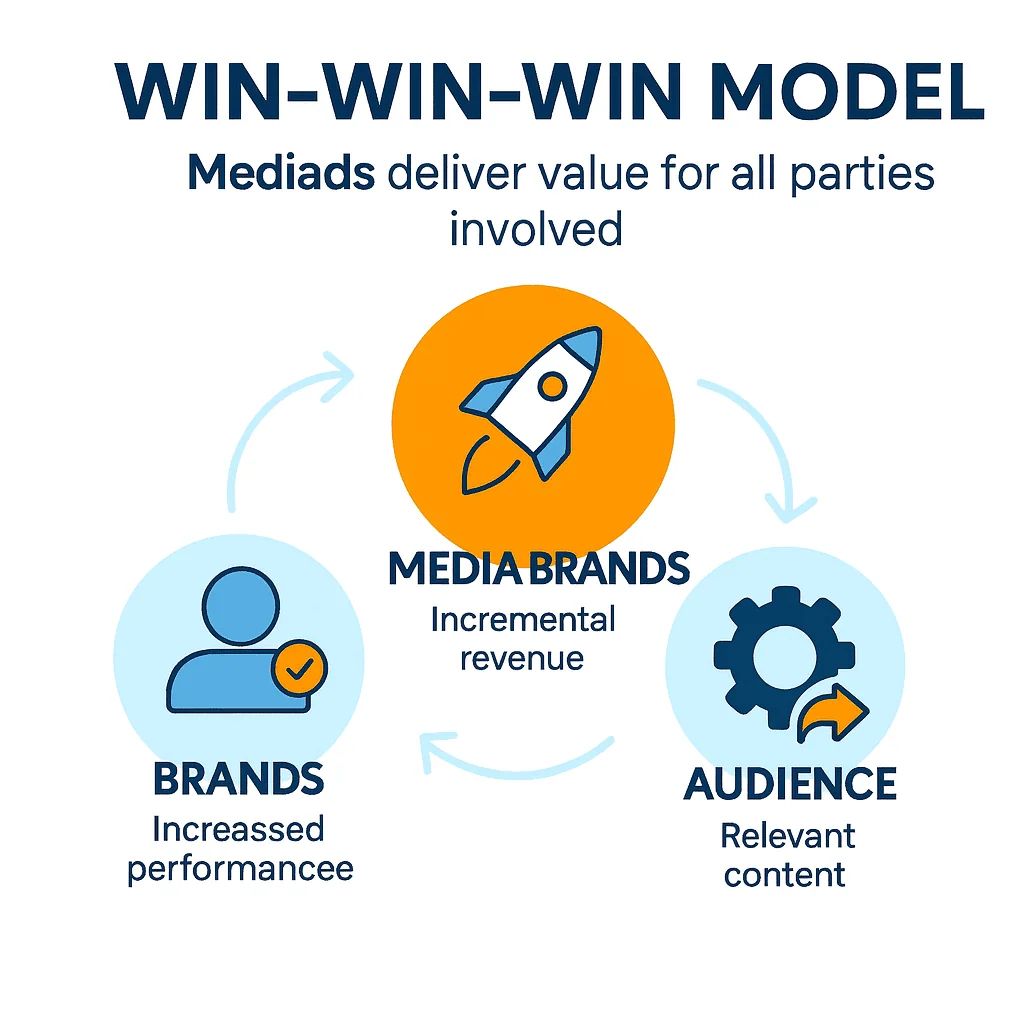
💡 Note: Partner publishers receive a share of this commission, making it a win-win-win model (advertiser, media, Mediads).
Mediads operates on a revenue-sharing model with its media partners.
Each campaign run on a media page results in a payout of a fixed percentage of the amount collected by Mediads.
This payment is net to the publisher, with no technical fees or commercial obligations. It is “bottom-line” revenue (EBITDA).
The media outlet approves each campaign in advance and retains control over its brand image.
This model allows publishers to generate incremental advertising revenue from their social media channels, with no operational effort and without impacting their editorial line.
Yes, absolutely.
Each advertiser can:
Choose one or more media outlets based on their industry or customer personas,
Ask Mediads for a strategic recommendation on the brands most relevant to their objectives (brand awareness, performance, positioning, etc.),
Approve each selection before activation.
💡 Example: An advertiser in the food industry might target a culinary or women’s magazine; a B2B brand would opt for a specialized business publication.
No.
The Mediads model is designed to be:
Flexible: no minimum volume or duration requirements,
Testable on a small scale: an advertiser can launch an initial campaign on a single media outlet to evaluate its performance,
Scalable on demand: if successful, the campaign can be expanded to other publications, verticals, or markets.
This approach allows advertisers to test risk-free and grow at their own pace.
| Player | What they bring | What they get |
|---|---|---|
| Advertiser | Budget, targeting, creative | Amplified performance (CTR, ROAS, CAC…) |
| Media brand | Reputation and credibility | Net revenue and brand value |
| Mediads | Technology and orchestration | Performance-based commission |
Data, tracking, pixels: what you keep under control
Management via the advertiser's BM, data ownership, GDPR compliance, and comprehensive funnel tracking.
Yes, that’s actually one of the Mediads model’s major advantages.
Because you manage your campaigns from your own Business Manager, you retain access to:
All the usual KPIs (impressions, CTR, CPM, conversions…),
Your tracking pixel to monitor performance across the entire marketing funnel,
To detailed reports in your native interfaces (Meta Ads, TikTok Ads, LinkedIn Ads, etc.).
💡 Unlike sponsored content published by a media outlet, here everything is traceable, measurable, and managed by you, within your own tools.
23. How does Mediads use your data?
Mediads’ technology does not access your proprietary data:
You do not share any audience data with Mediads,
We have no access to your advertising history or your first-party data.
Our role is to coordinate the distribution of your campaigns through the social media pages of our media partners. At no time does Mediads capture or store your strategic assets.
✅ Your audiences, your pixels, and your results belong entirely to you.
Yes, it’s actually a key pillar of our model.
Your tracking pixel continues to collect all performance data related to campaigns run through Mediads. This allows you to:
Track results in granular detail, including post-click data,
Measure the actual impact on your business KPIs (sales, conversions, CAC, ROAS, etc.),
Enrich your retargeting or lookalike audiences, just as you would in your traditional campaigns.
🎯 Result: no disruption to your management workflow, but improved performance thanks to Social Publishing.
Absolutely.
Mediads upholds high standards of confidentiality at every level:
Your data is neither resold, exploited, nor used for any purpose other than the delivery of your campaigns.
Your performance metrics are never shared with third parties (including publishers or competitors).
Our contracts with media partners include strict confidentiality and exclusivity clauses.
You retain full ownership of your data in a secure environment that complies with industry standards.
Setting Up Your First Campaign: Prerequisites, Support, and Testing
Plug-and-play, customized support, technical requirements, rapid testing logic.
No technical integration is required. Mediads is designed to work seamlessly with your existing tech stack.
Here’s how it works:
You continue to manage your campaigns from your usual Business Manager (Meta, TikTok, LinkedIn...),
You use your existing audiences,
You keep your tracking pixel,
You set your objectives, creatives, budgets, and targeting as usual.
💡 Mediads simply adds a third-party distribution layer (the media), without changing your internal processes. It’s a plug-and-play solution, 100% operational from the very first campaign.
Here are the minimum requirements to launch a campaign with Mediads:
Have an active advertising account on Meta, TikTok, or LinkedIn,
Have an active pixel connected to your website or CRM,
Be able to manage a campaign using your native tools,
Be open to running ads on selected and jointly approved media pages.
💡 If you’re already running social ads, you can get started with Mediads right away.
Every advertiser receives personalized support, included in the monthly subscription:
A private channel with our team for daily monitoring,
Strategic recommendations on media selection, messaging, and timing,
Responsive technical and operational support (setup, validation, monitoring, etc.),
Regular performance reviews tailored to your business objectives.
🎯 Mediads is an augmented solution: you’re in the driver’s seat, but you’re never alone.
Yes, it’s actually recommended.
We encourage every new client to test the platform on an initial campaign, with:
A controlled budget (starting at a few thousand euros),
One or two media outlets selected together,
A short activation period (1 to 2 weeks).
This test allows you to validate the performance promise, with no commitment or risk.
If the results are positive, scaling up is simple, fast, and scalable.
Mediads alle Werbeformate, die von sozialen Plattformen (Meta, TikTok, LinkedIn usw.) angeboten werden, sofern sie den Richtlinien und Spezifikationen der jeweiligen Kanäle entsprechen. Sie behalten die vollständige Freiheit bei Ihren Kreationen und profitieren gleichzeitig von der Verbreitung über unsere Medienpartner. Hier ein Überblick über die wichtigsten Formate:
-
Einzigartiges Bild
-
Formate: JPG, PNG, GIF (statisch oder animiert)
-
Gängige Größen: 1200 × 628 (Feed), 1080 × 1080 (quadratisch), 1200 × 1507 (Geschichten)
-
Ideal für: klare Botschaften, Markenbilder, Werbeangebote
-
-
Karussell
-
Bis zu 10 Karten mit jeweils einem Bild oder Video
-
Möglichkeit, einen separaten Link pro Karte hinzuzufügen
-
Ideal für: mehrere Produkte präsentieren, Funktionen vergleichen, eine Mini-Geschichte erzählen
-
-
Video-In-Feed
-
Formate: MP4, MOV, M4V, animiertes GIF
-
Empfohlene Dauer: 5–15 Sekunden (Stories), 15–60 Sekunden (Feed), bis zu 2 Minuten auf LinkedIn
-
Seitenverhältnis: 16:9, 4:5, 1:1
-
Vorteil: Aufmerksamkeit durch Bewegung wecken, Anwendungsfall oder Erfahrungsbericht präsentieren
-
-
Geschichten & Reels (vertikaler Vollbildmodus)
-
Verhältnis 9:16, Dauer 15 s (Facebook/Instagram Stories), 30 s bis 60 s (Reels, TikTok)
-
Rich Media möglich: Umfragen, Sticker, AR-Effekte (Meta)
-
Verwendung: immersive Formate, hohe Sichtbarkeit, ideal für „Teaser“
-
-
Sammlung & Sofortiges Erlebnis (Leinwand)
-
Ermöglicht die Erstellung einer mobilen Mini-Website innerhalb von Facebook/Instagram.
-
Kombinieren Sie Bilder, Videos, Karussells und Lead-Generierungsformulare.
-
Hervorragend geeignet für: geführte Shoppingtour, Katalogpräsentation
-
-
Dynamische Anzeigen und Kataloganzeigen
-
Automatische Verbreitung von Bildern/Videos aus Ihrem Produktkatalog
-
Retargeting-Targeting: Besucher Ihrer Website, Warenkorbabbrüche, Lookalikes
-
-
Lead-Anzeigen / LinkedIn-Lead-Generierungsformulare
-
In die Werbung integrierte Formulare zur direkten Erfassung von Leads
-
Personalisierung der Felder (Name, E-Mail, Telefon)
-
Kompatibel mit Ihrem CRM über API oder Zapier
-
-
Spielbare Anzeigen und AR-Anzeigen (TikTok, Snap)
-
Interaktive Formate: Minispiele, AR-Erlebnisse
-
Hohe Interaktionsrate, ideal für Produkteinführungen oder Kampagnen für junge Zielgruppen
-
Zu beachten:
Alle von den Plattformen unterstützten Formate sind mit Social Publishing Trusted Social Ads Mediads kompatibel.
Es ist kein technischer Eingriff seitens des Herausgebers erforderlich: Sie liefern Ihre Kreationen im Standardformat, und wir organisieren die Verbreitung.
Beachten Sie stets die Werberichtlinien und die Vorgaben hinsichtlich Größe/Dauer jeder Plattform, um eine schnelle Validierung ( Mediads Vorabvalidierung Mediads ) zu gewährleisten.
Common Objections & Misconceptions: Questions We’re Often Asked
Competitors, media approval, creative oversight, tight budgets, compliance, confidentiality.
Yes, it’s possible—and it’s neither a problem nor a threat.
- On social media, all advertisers are already competing in news feeds. The fact that they’re served by the same media brand doesn’t change that.
- With Mediads, campaigns aren’t shown to the media outlet’s audience, community, or followers: they’re targeted exclusively at the audiences chosen by the advertiser (via their Business Manager).
This means you retain complete control over your ad delivery, targeting, and objectives.
👉 In summary: the media page acts solely as a credibility booster (trusted layer). But the distribution strategy remains entirely customized, confidential, and separate from those of your competitors.
Final campaign approval always rests with the partner media brand, but in practice, the risk of rejection is extremely low.
-
Mediads teams systematically run an internal pre-approval before any submission to a publisher.
-
We know each partner's editorial requirements inside out, which allows us to screen content upstream and prevent any rejection.
-
Over time, these requirements have loosened significantly — today they only apply to a handful of specific media brands, in very particular cases.
📊 The average campaign approval rate is above 99.9%.
And if a campaign were ever rejected:
-
Mediads immediately offers an equivalent alternative, approved with another partner media brand,
-
Nothing is ever published without your approval.
👉 Bottom line: approval is a formal step, but one that is fully managed and anticipated — it creates zero operational friction in running your campaigns.
Never.
-
You keep 100% creative control: visuals, messaging, formats, campaign objective.
-
Mediads can share strategic recommendations if you'd like, but nothing is ever changed without your approval.
-
The partner media brand can only approve or reject a creative — never edit it.
👉 Respecting creative integrity is a cornerstone of how we work.
Yes, fully.
-
Campaigns delivered through Mediads comply with each platform's ad transparency rules (e.g., "Sponsored" or "Paid partnership" labels on Meta).
-
Your first-party data is never transferred, processed, or shared.
-
All operations are conducted within a GDPR-compliant framework, on both the advertiser and publisher sides.
